You have made up your mind to buy a mountain bike but noow you are faced with a har choice, Should you choose full suspension or a hardtail? The short answer is that neither is better for every rider. A full suspension bike is more comfortable and more controllable. on rough terrain. A hardtail often costs less and requires less maintenance. It also feels responsive on smoother trails. But the right choice involves considering more things than just the trail beneath your tires. It depends on your budget and how much maintenance you’re prepared to take on.
We will make a detailed comparison in this blog between the two and give you clarity regarding which one deserves a place on your trails.
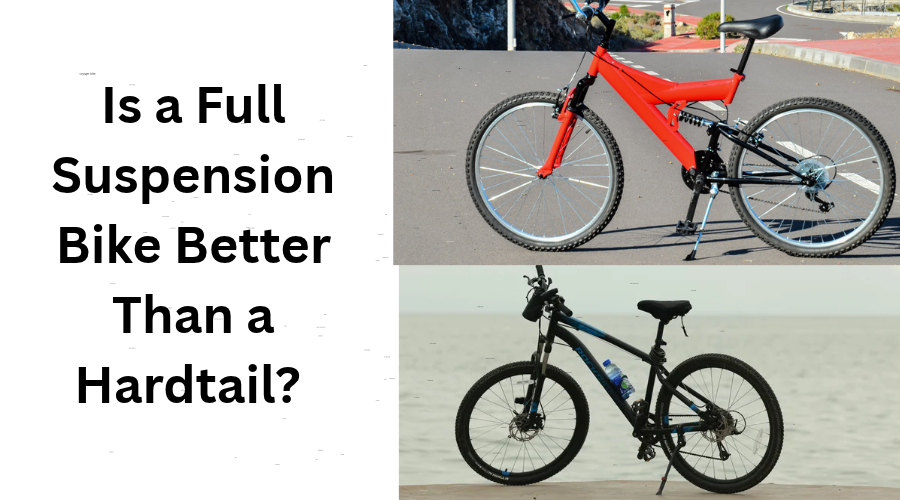
A hardtail mountain bike features a rigid rear frame and a suspension fork on the front.
The fork helps absorb impacts from the front wheel, but there is no rear shock to absorb bumps at the back.
That means you feel impacts of the trail through the rear end of the bike. On smooth or moderately rough terrain, the direct feel during handling makes the bike ride lively and responsive. On rockier ground, you’ll need to use your body position more actively to manage the bumps.
Hardtails are available for different types of riding. Some focus on cross-country speed and low weight, while others are built with trail-friendly geometry for more demanding terrain.
A full suspension mountain bike has a rear suspension system and suspension fork at the front which is usually made up of a shock and moving frame components.
The rear suspension allows the back wheel to move as you ride over uneven ground. That can help the wheel maintain contact with the trail, improving traction and reducing the impacts passed on to you.
Full-suspension bikes also vary by function. A cross-country model is specially made for efficient pedaling and lower weight. In contrast, an enduro or downhill bike is designed for more challenging descents.
|
Factor |
Hardtail |
Full suspension |
|
Suspension |
Front suspension, rigid rear |
Front and rear suspension |
|
Best suited to |
Smoother trails and riders who value simplicity |
Rougher, more technical trails |
|
Climbing |
Often responsive on smooth climbs |
Rear traction can help on rough climbs |
|
Descending |
Requires more active line choice on rough ground |
Generally offers more comfort and control on rough descents |
|
Comfort |
More trail feedback reaches the rider |
Rear suspension absorbs more bumps |
|
Weight |
Often lighter than a comparable full-suspension bike |
Often heavier because of the rear suspension system |
|
Purchase cost |
Typically lower for a comparable specification |
Typically higher for a comparable specification |
|
Maintenance |
Fewer suspension components to maintain |
Rear shock and frame pivots add maintenance |
These are general comparisons, no guaranties. There are so many other factors that come into play on a ride like bike design, tires, suspension setup and your own riding style.
You often get more for your budget. A hardtail has a simpler frame design, so a bike at a given price comes with better components than a similarly priced full-suspension model. That could mean a better fork, brakes, or drivetrain.
Maintenance is simpler. Although you still need to service the front fork and maintain the rest of the bike. But without a rear shock and suspension pivots, there are fewer parts to inspect and service.
The ride handling feels direct. A hardtail feels responsive when you accelerate or climb on smooth ground. That additional contact feedback from the tires contacting the ground makes the ride more enjoyable.
Rough trails demand more from your body. Every bump from rocks and roots pass more movement through the rear of the bike. Your body encounters every shock. Over a long ride, that can feel tiring.
Rear-wheel traction takes more active management. On uneven climbs and descents, you constantly need to adjust your position to keep the rear tire gripping and on the ground.
Uncomfortable ride on rough terrain. A hardtail tackles technical trails in capable hands. But the major drawback here is it does not feel as comfortable as a suitable full-suspension bike when the terrain stays rough for long stretches.
Ride comfort level is better on rough ground. Rear suspension absorbs some of the impacts that would otherwise be felt by you. This makes long rides on rough terrain feel less tiring and more tolerable.
You have traction where it matters. When the rear wheel bounces more freely over rocks and roots, it stays in contact with the ground. This gives you an edge on technical climbs as well as descents.
Technical descents are easier to control. A suitable full-suspension bike helps the rider manage repeated bumps and uneven surfaces. For beginner-level bikers it facilitates them through difficult sections of the trail.
The bike is higher priced. A rear shock and more complex frame structure adds to the bike’s price tag. At the same budget, you will need to compare component quality carefully for the right choice.
Bike maintenance requires more effort. The additional components like rear shock and bearings also need care and attention in addition to the usual fork, brakes, drivetrain etc.
The bike may weigh more. Rear suspension adds parts and weight, although the difference varies considerably between models.
It can be but that highly depends on type of climb.
A hardtail often feels efficient and responsive on smooth dirt, gravel roads, and less technical climbs. Its rigid rear frame does not move through suspension travel as you pedal, and a comparable hardtail may weigh less.
But that does not mean every hardtail climbs better than every full-suspension bike. A number of other features like frame design, gearing and tires affect the result.
A full-suspension bike can have an advantage when the climb is uneven. The rear suspension helps the wheel follow the ground, which can improve traction when you’re pedaling over roots or loose rocks.
If your local climbs are difficult, therefore, you'll need rear suspension to keep your momentum going through a relatively less stable rigid rear wheel.
When riding on a challenging, uneven down slope a quality full suspension bike will offer greater comfort level since the rear shock provides cushioning from the continuous impact. Rear wheel also provides better traction on uneven surfaces. The ride quality is improved as you become more comfortable traveling over rocks, roots and rough corners. But not every descent is a breeze with full suspension bike. The right technique and equipment for the trail is still required.
A hardtail is a practical choice if you want a simpler bike and have a tight budget. It allows you access to a broad range of trails without adding rear-suspension maintenance.
If your preference is a lighter bike and you spend much of your time riding on smoother trails, a cross-country hardtail will suit you well.
On the other hand, if your routes include extended rough sections, a cross-country full-suspension bike offers extra traction and comfort without necessarily moving you into a heavier, long-travel trail bike.
Trail riding includes a broad range of terrain. So, a capable hardtail is all you need for smooth trails with occasional bumpy sections. But if your usual rides includes surfaces with roots, rocks, and rough descents, a full-suspension trail bike is worth the higher price.
Enduro and downhill riding puts more load on a bike during steep, rough descents. Full-suspension bikes designed for these track conditions are commonly chosen for their ability to absorb sustained impacts while navigating the track.
A hardtail is better option here. It has a simpler setup and provides convenient mounting options for bags and equipment.
A full-suspension bike has the winning edge on comfortable ride offer on a rough route, but its frame and moving parts becomes its weakness when you are carrying gear.
The correct action is to check the specific bike’s mounting points and carrying limits before deciding.
At the same price, a hardtail offers a better component value because its frame is less complex. You still need to compare bikes models. Here you should look closely at the fork, brakes, drivetrain, wheels, and tires.
A full-suspension bike will be worth the additional investment if your terrain is uneven. But paying more for rear suspension is not automatically good value if most of you mostly ride is on smooth paths.
Both types need routine maintenance so neglecting is not an option. You will need to maintain the chain, brakes, tires, and front fork whichever bike you choose.
A full-suspension bike also has a rear shock and frame pivots or bearings that need inspection and servicing. Service requirements vary by component, riding conditions, and manufacturer, so check the schedules for the specific bike you are considering.
Are planning to ride on mostly smooth trails and tracks.
Wanting a simpler bike with that is less of a hassle to maintain.
Are needing to get the most value in a tighter budget.
A full-suspension bike is better if its strengths are matched to your riding conditions. Rear suspension makes a real difference to your comfort and traction if your trails are rough.A hardtail bike is better when you value simplicity, enjoy feeling the shocks. Or if you want a better component value for your budget.
You have made up your mind to buy a mountain bike but noow you are faced with a har choice, Should you choose full su...
READ FULLWhen your bike can’t absorb the constant hits, riding on rocky trails, tree roots and uneven ground quickly bec...
READ FULLFolding or electric folding bikes are a modern version of standard bicy...
READ FULL